
FAQ
Frequently asked questions
Everything about MPC: recruitment, activities, training, projects and sponsorship.
32 questions
We plan to recruit new members during the first semester of each year! Please visit our official Facebook page and follow us to get the latest updates!
MPC is a home for students passionate about programming, coming from various technical majors such as Information Technology, Information Security, Computer Science, Artificial Intelligence, etc. Additionally, students from other majors also have the opportunity to join MPC if they have skills in graphic design, media, and event organization.
Of course! MPC does not require members to have specialized programming knowledge. The club's goal is to create an environment for learning, researching, and developing information technology for everyone who is passionate about programming.
Each year, the club organizes member recruitment on its official Facebook page as well as on the club's website. You just need to participate in the recruitment event, engage in club activities, and demonstrate a spirit of learning, creativity, and passion for programming, and you will have the opportunity to become an official member of the club.
The Mobile Programming Club (MPC) was established in 2015. Initially, the club was founded with the goal of creating an environment for learning, researching, and developing information technology — not only on mobile devices such as web, mobile apps, etc., but also in many other popular fields for IT students.
Organize knowledge-sharing workshops to review fundamental programming courses for students. Establish study groups under the "Students as Academic Advisors" model. Provide training for members on mobile device programming. Organize academic competitions applying specialized knowledge, such as ROBOCODE.
The club is currently divided into 4 main departments: Executive Board: Manages all club activities. Logistics Department: Manages and organizes activities, decorations, finances, and sponsorship outreach. Programming Department: Organizes training sessions, study groups, and programming practice. Communications Department: Manages media activities, PR, design, filming, and photography.
Currently, MPC has approximately 50 official members, with the majority being from the IT faculty.
Besides professional activities, the club also organizes many extracurricular activities such as: Club birthday celebrations, Team building events, Volunteering activities, Member meetups, and collaborative events with partner clubs at the university.
The club collects a small annual activity fee to maintain general operations. The fee amount will be announced at the beginning of each academic year and depends on that year's activity plan.
Yes! Robocode is an annual virtual robot programming competition organized by MPC. It's a playground that helps students practice logical thinking, algorithms, and strategy through programming robots that compete in a virtual arena.
MPC organizes training for members across many technology areas: web development (HTML/CSS, JavaScript, React, Next.js), mobile development (Flutter, React Native), basic DevOps, UI/UX Design, and essential soft skills for developers.
The training roadmap typically lasts 8-12 weeks with sessions on weekends. Each session lasts about 2-3 hours, combining theory and hands-on practice on real projects.
Mentors are core members, alumni who have practical experience working in the IT industry, or lecturers invited from the Faculty of Information Technology at Ho Chi Minh City Open University.
Club members can register to participate in real projects by contacting the Executive Board or following the recruitment calls for product development from the Programming Department. You will have a light interview to select the right position (Frontend, Backend, Design, Tester).
Yes! When joining a project, you will be directly guided by experienced senior members (Mentors). You will also get access to professional workflows (Git, Scrum/Agile) and modern technologies.
Yes, most useful applications (such as the Club Portal, Academic Support Extension) are deployed for practical use by students in the school or put on GitHub as open source.
Businesses and organizations can contact us directly via email or our official fanpage. The Executive Board will send a detailed sponsorship proposal including benefits and suitable partnership packages.
Sponsors receive brand promotion across the club's media channels (website, fanpage, event publications), logo placement on event backdrops and banners, priority recruitment access to club members, and other benefits depending on the sponsorship package.
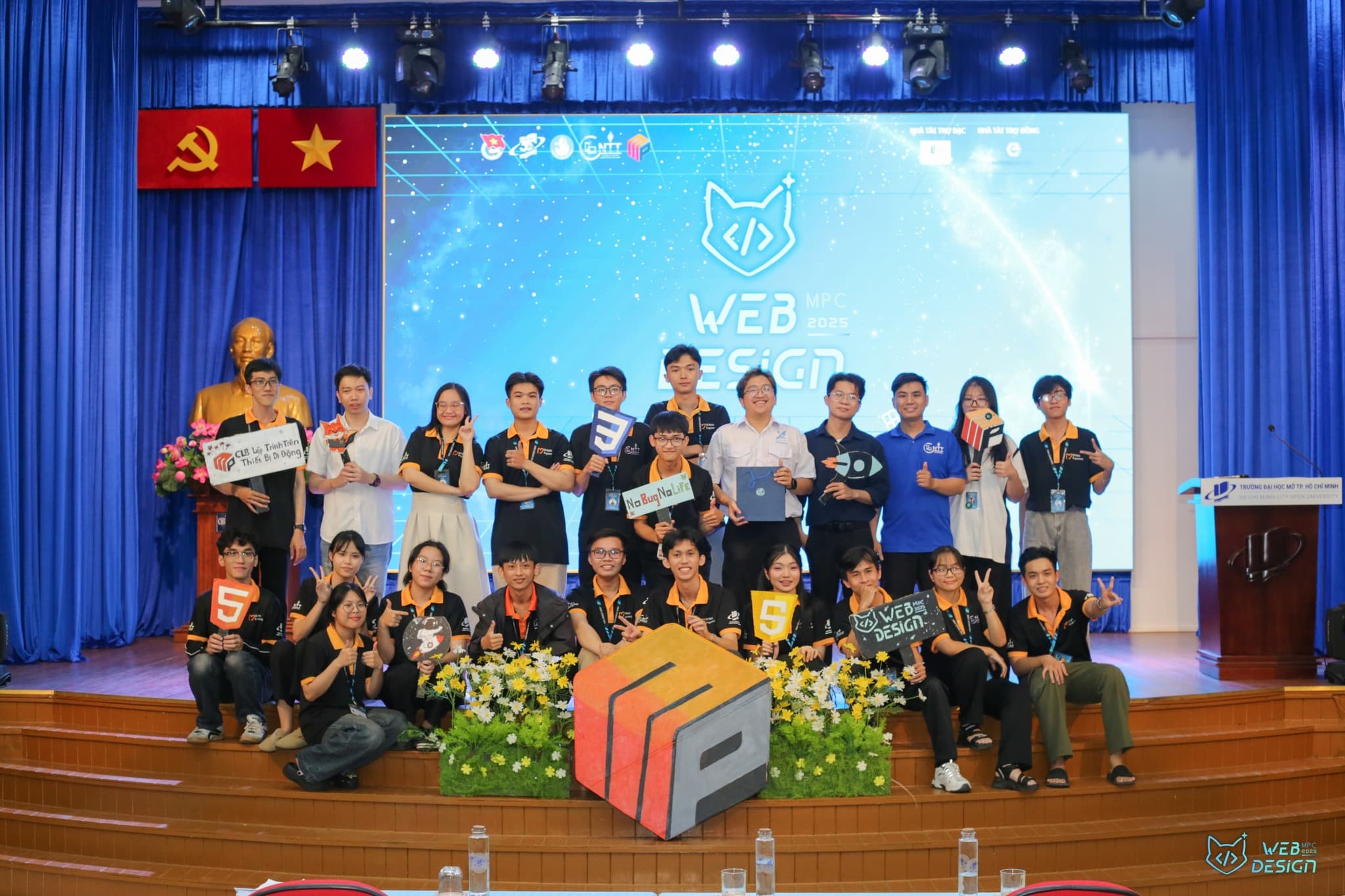
Web Design is an annual web design and front-end development contest organized by the Mobile Programming Club (MPC). In 2026, teams build a landing page for a fictional business in a drawn field, with White Label as the core criterion: the brand, content and colors can be changed without touching the source code.
All students currently enrolled at Ho Chi Minh City Open University. Each team has 2–3 members, with at least one member from the Faculty of IT or the Special Training Faculty (IT track); other members may come from any faculty. Up to 15 teams are accepted.
We know many of you could easily go solo 🐧 But to encourage collaboration and teamwork, every team must have 2–3 members.
Absolutely! The rules are designed for every cohort: first-years get to try new technologies, while seniors get to revisit the skills they may have let "fall asleep" 😄
Yes. A team only needs at least one member from IT/Special Training. Design, copywriting and presentation skills are all valuable for a strong team.
A website deployed and accessible on the internet, with White Label capability — the brand (content, colors, logo, fonts, images) can be changed without editing the source code. Teams prepare at least 2 different content sets from the same code base for the demo.
NOT allowed: UI frameworks (React, Vue, Angular, Svelte…), prebuilt UI kits/templates (Bootstrap, DaisyUI, Tailwind UI, Flowbite, MUI, Ant Design…) and tools that need a build step. ALLOWED: plain HTML, CSS, JavaScript, core Tailwind CSS and utility libraries such as Three.js, GSAP, AOS and icon sets. Rule of thumb: libraries that give you tools are fine; libraries that give you a ready-made interface are not.
No. The contest is front-end only; data is mocked with JSON files or similar. You may call third-party APIs/services directly from the browser (AI APIs, form services…), but you may not write your own server.
It's completely free. You can use GitHub Pages, Vercel, Netlify or any free static hosting. Deployment is required from the Implementation round onward — not in the Qualifiers.
Entries are judged on: visual aesthetics & creativity, White Label architecture (the core criterion), UX features & responsiveness, animation & effects, clean code & project structure, use of AI, and teamwork (via GitHub history). The Finals add a live customization demo, the presentation and a Q&A defense.
Yes, and it's encouraged — for planning, content, complex effects, code review and documentation. Three limits: (1) you must understand and explain your own code — judges will ask at random; (2) be transparent: share prompts for complex effects, and your AI-usage report must match your commit history; (3) avoid AI slop — it is heavily penalized.
It's output that looks mass-generated by AI with no human touch: a formulaic hero → 3 columns → testimonials → footer on every page, default purple–pink gradients, glossy 3D icons unrelated to the content, stock imagery that doesn't fit the business, and generic copy. To avoid it: let AI assist, but decide and refine the layout, colors and design ideas yourselves.
Copying the design or code of an existing project without attribution leads to disqualification. Drawing inspiration is fine, but you must design and code it yourselves.
Still curious?
Join an MPC activity
The quickest way to get to know the club is to join an activity. Browse MPC's internal activities and public events.